

x
bbmri-eric website

I am looking for information as
Researcher

Industry
Patient
How research infrastructures are bridges to connect Europe and deliver for the Cancer Mission
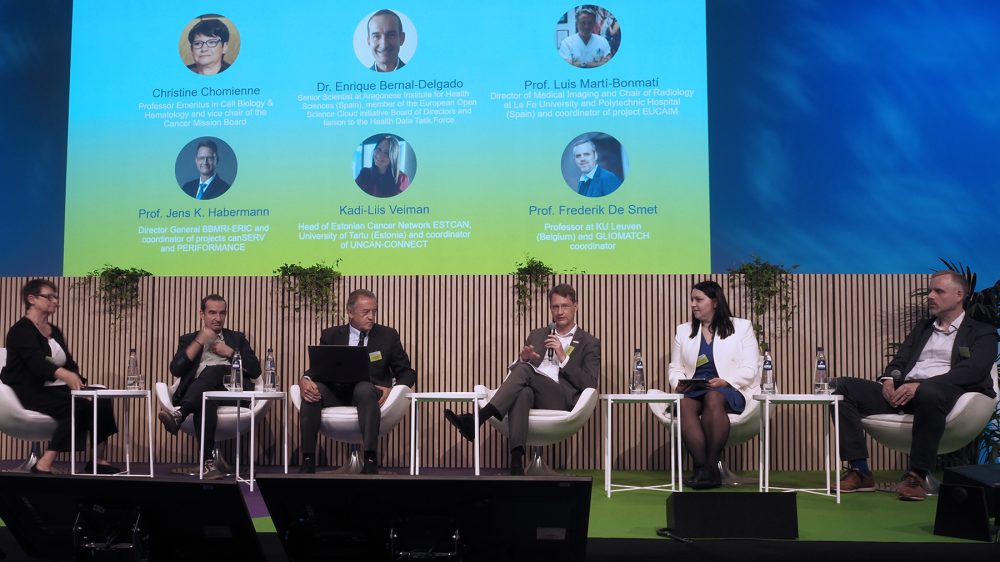
Prof. Jens K. Habermann, BBMRI-ERIC Director General, contributed a key intervention on the opening day of the European Commission event ‘5 Years EU Cancer Mission: Stronger Through Connection’.
Marc Lemaitre, Director-General for Research and Innovation, opened the session by emphasising that strengthening infrastructures, data capacities, and collaboration networks is an important next step. The panel, ‘Understanding cancer and importance of data exchange part 1: building a coherent cancer data ecosystem’, was chaired by Christine Chomienne, Vice-chair of the Cancer Mission Board, and took place on 29 September in Brussels.
Watch the video below to see Prof. Habermann cover the points.
canSERV accelerating cancer research
Prof. Habermann showcased the difference that canSERV has made for accelerating cancer research across Europe. A gateway that enables researchers to access over 500 services from 13 distributed research infrastructures, it has facilitated 156 projects using 254 services across 27 different countries, of which 6% are small and medium enterprise (SME) driven initiatives. The data generated by this cross-border and collaborative research will be made available for future benefit in the upcoming UNCAN platform.
The European Molecular Tumour Board
The unique canSERV European Molecular Tumour Board Network has united 270 clinicians and scientists from 36 countries across the globe to support patients whose treatment options are limited. The EMBTN features consensus guidelines, a handbook for running a molecular tumour board and a Molecular Tumour Board (MTB) outcome registry.
Fostering cancer research through EOSC
Prof. Habermann, sharing the podium with EOSC Director Enrique Bernal-Delgado, highlighted how European Research Infrastructures (ERICs) are part of the European Open Science Cloud (EOSC) Federation that will play a substantial role in fostering cancer research beyond individual infrastructure capabilities.
BBMRI-ERIC is amongst the first 13 EOSC Nodes building the Federation and is present as a thematic, self-standing, node, representing the sensitive health data domain. Its activities will enrich the European Health Data Space (EHDS).
In fewer than six months, the BBMRI-ERIC EOSC Node connected institutions across borders to contribute a use case on multi centric validation of AI models for prostate cancer screening. It proves the ability of the EOSC Federation to foster cancer research in a way that one single node or one individual research infrastructure alone cannot do.
Bridges between disciplines and sectors
Prof. Habermann closed by emphasising the value of stronger connections – the Cancer Mission event theme:
“ERICs offer substantial expertise and service for European competitiveness and are scalable to the needs of academic, industry R&D to provide services along the entire value chain.
“BBMRI-ERIC, and RIs specifically in the Health and Food cluster, are strong assets to implement the EU Life Science Strategy 2030, including the Clinical Research Investment Plan and the Digital Europe Programme.”
Taking the initiative
BBMRI-ERIC supports the Cancer Mission through several major initiatives including coordination of canSERVand PERIFORMANCE, participating in EU-CiP and CANDLE and as technical partner for UNCAN-Connect to develop the UNCAN platform.
About the 5 Years EU Cancer Mission: Stronger Through Connection event
From 29 September to 1 October 2026, the European Commission brought together researchers, clinicians, policymakers, patients, innovators, funders and industry representatives in Brussels to mark five years of the EU Cancer Mission and look at the road ahead to fully achieve its 2030 goal, alongside Europe’s Beating Cancer Plan.
Across three days of inspiring discussions, interactive sessions and project showcases, the event spotlighted breakthrough ideas, bold collaborations and the people driving change across Europe’s cancer ecosystem.
From prevention and early detection to personalised medicine, and quality of life, the programme explored how stronger connections are helping transform cancer research and care across Europe.
About BBMRI-ERIC
BBMRI-ERIC is the European research infrastructure (RI) for biobanking and biomolecular resources, one of the largest RIs in the health and life sciences. Set up in 2013, it includes around 500 biobanks within 29 Nodes from 28 Member and Observer countries plus the global organisation IARC/WHO.
A distributed research infrastructure, BBMRI-ERIC enables the development of innovative technology and processes as a cross-domain network that facilitates responsible access to high quality samples, data and biomolecular resources. We achieve this through multidisciplinary expertise and service provision, scientific excellence, knowledge exchange and partnerships in health and life sciences. BBMRI-ERIC’s vision is simplified as: “Biobanking for a Healthier World”. Its h